
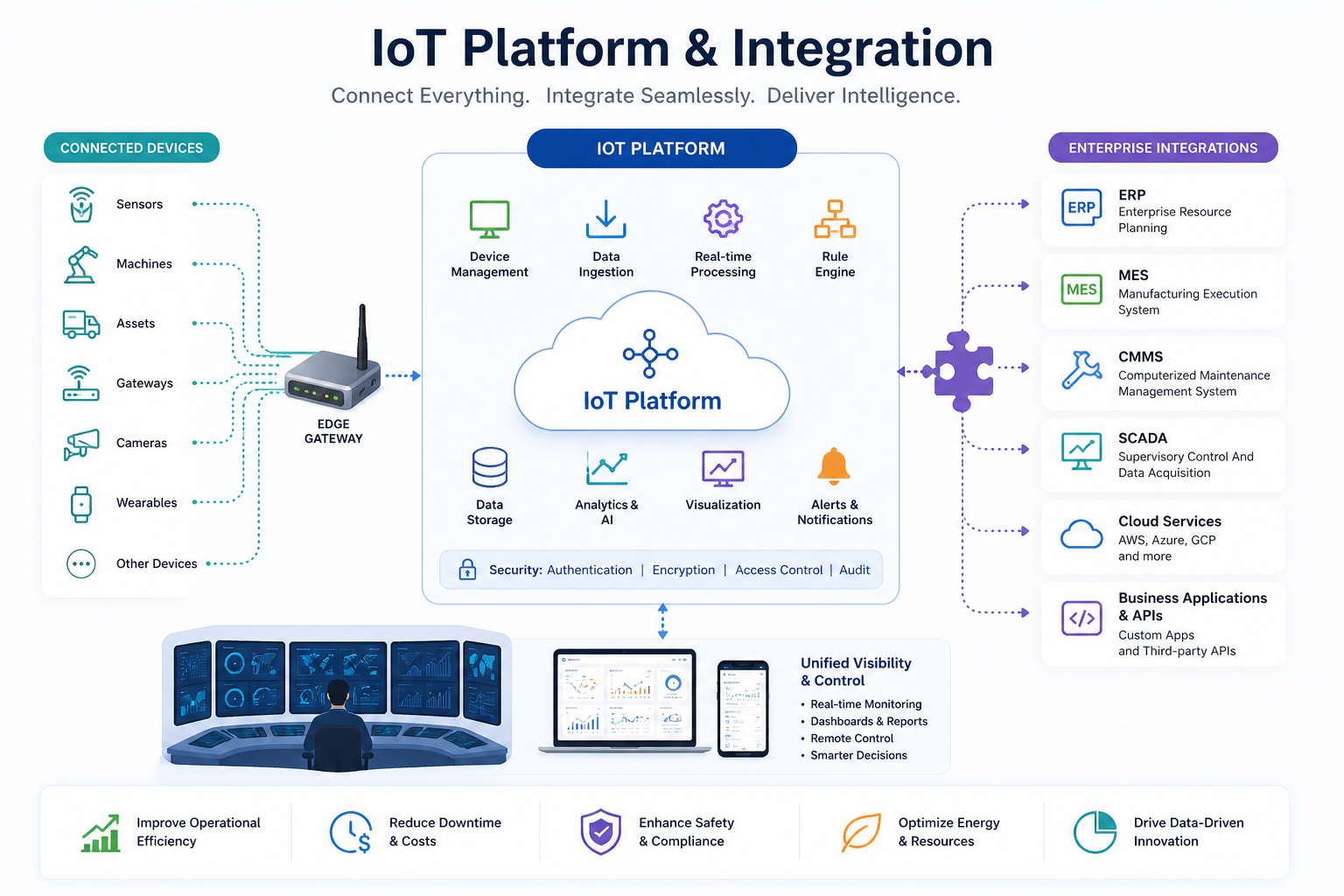
The Iot Platform and Integration diagram above presents the flow of telemetry data and control from:
The overall concept emphasizes:
On the left side, the image shows multiple categories of connected field devices:
These represent the physical components of an IoT ecosystem.
These devices continuously generate operational data such as:
This is the “data source” layer of the architecture.
All devices connect first to an Edge Gateway.
The gateway acts as a bridge between operational devices and the cloud platform.
Its responsibilities typically include:
Instead of sending all raw data directly to the cloud, the gateway can:
This is especially important in:
At the center is the cloud-based IoT Platform, which acts as the brain of the system.
The platform includes several core capabilities:
Handles lifecycle management of IoT devices:
This allows centralized control of thousands of devices.
Collects streaming data from connected devices using protocols such as:
The ingestion layer ensures scalable and reliable data collection.
Processes incoming data instantly to:
This enables immediate operational awareness.
Automates business logic using predefined conditions.
Examples:
This supports industrial automation and predictive operations.
Stores historical and operational data for:
Typically includes:
Transforms raw IoT data into actionable insights.
Capabilities may include:
This is where operational intelligence is generated.
Provides dashboards and monitoring interfaces.
The image also shows desktop and mobile dashboard interfaces, emphasizing accessibility from multiple devices.
Automatically notifies operators when important events occur.
Examples:
This helps organizations respond quickly to operational issues.
At the bottom of the IoT Platform box, the diagram highlights security features:
IoT environments involve many connected endpoints, making cybersecurity critical.
These security controls protect:
Security is foundational for enterprise-grade IoT deployments.
On the right side, the IoT platform integrates with business and operational systems.
Used for:
IoT data can improve operational and business decision-making.
Used in manufacturing environments to:
Real-time machine data improves production visibility.
Supports maintenance operations such as:
Supervisory systems used for industrial process control.
Integration enables:
Integration with cloud providers such as:
Supports scalability, storage, analytics, and AI services.
Allows integration with:
This creates a flexible digital ecosystem.
The bottom-center section highlights operational benefits:
This represents the operational command center enabled by IoT.
Organizations gain centralized visibility across all connected assets and processes.
The bottom row summarizes the strategic outcomes of the architecture.
Automation and real-time monitoring reduce manual effort.
Predictive maintenance helps avoid unexpected failures.
Continuous monitoring improves workplace safety and regulatory compliance.
IoT analytics helps reduce waste and energy consumption.
Organizations can use operational data to innovate products, services, and business models.
This image represents a modern industrial IoT ecosystem where:
The architecture is highly relevant for:
It communicates the idea of a fully synchronized digital operation powered by connected technologies, analytics, and enterprise integration.
Apr 27, 2026

Category: General
Zigbee is a low-power wireless mesh network standard delivering low-latency communication and targeted at battery-powered devices in wireless control and monitoring applications.
[More]
Apr 27, 2026
Category: General
By embracing connected technologies, manufacturers can move beyond basic automation toward truly intelligent operations.
[More]
Apr 26, 2026
Category: Use Case
Integrate surveillance, sensors, and alerts to enhance safety in public areas.
[More]
Email: info@syncs.id